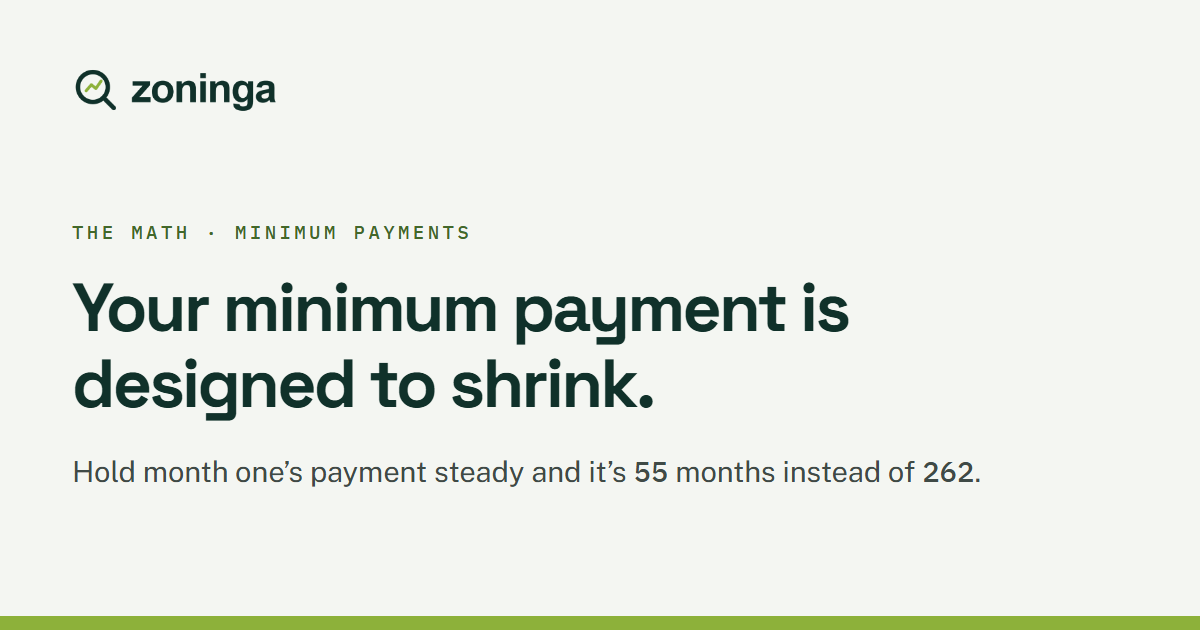
Why Your Credit Card Minimum Payment Will Never Pay Off the Card

By Kyle Rice | Reading time: ~4 minutes
Technically, it will. In about 22 years.
Pay only the minimum on a typical card balance and you will eventually reach zero, after paying roughly twice your original balance in interest along the way. The minimum payment is working exactly as designed, which never included getting you out of debt.
Here's the math.
All numbers below are examples. Your card's terms will differ.
How your minimum payment is calculated
Most issuers use some version of this formula:
Minimum payment = 1%-3% of your balance + that month's interest (with a floor, often $25 to $35).
Some use a flat 2% of the balance instead. Either way, the formula scales with your balance. As your balance falls, your required payment falls with it. A payment that shrinks as you make progress sounds friendly, but it is the reason the payoff takes two decades.
The worked example
Say you're carrying $6,500 at 24.99% APR, a common rate on store cards and plenty of ordinary rewards cards right now.
Month one, your minimum payment is about $200.36. That feels substantial until you look inside it:
- Interest that month: $135.36
- Principal: $65.00
Sixty-eight cents of every dollar you sent went to interest. Your $6,500 balance became $6,435. You paid $200 to move the needle $65.
Why the balance barely moves
Now the formula's downward design kicks in. Next month your balance is slightly lower, so your required minimum is slightly lower too. By month 12 the minimum has drifted down to about $179. Five years in it's about $111, and at the ten-year mark you're paying about $61 a month while still owing nearly $2,000.
Your payment keeps shrinking to match your shrinking balance, so the payoff keeps receding. Run the whole schedule and the minimum-only path on this card comes to:
- Time to zero: 262 months, which is 21 years and 10 months
- Total interest paid: about $12,402 on the original $6,500 balance
Those numbers come from a normal card, a normal balance, and a borrower doing exactly what the statement asks.
This is also why "I pay it every month and the balance never goes down" is one of the most-asked money questions on the internet. The balance is going down, at $65 a month, a snail's pace.
One option: freeze the payment
Take your current minimum, $200.36 in our example, and keep paying that exact amount every month, even as the statement asks for less.
Same card, same rate, and a first payment identical to the one you were going to make anyway:
- Minimum only (shrinking payment): 262 months, $12,402 interest
- Frozen at $200.36: 55 months, $4,444 interest
That's 17 years and roughly $8,000 of interest gone, without ever paying more than your first bill. Every dollar the minimum payment lowers by becomes principal instead.
Round up and it gets better fast. At a flat $300 a month, this card is gone in 30 months with about $2,234 of interest.
Why issuers set the minimum this low
The minimum payment exists to keep your account current. A low minimum keeps default rates down and keeps the balance, and the interest it generates, alive for as long as possible. Since the CARD Act of 2009, US statements must show you the cost of minimum-only paying in a disclosure box. Make sure you look at yours.
What to do
-
Find your real numbers. Your APR and balance are on your statement, and the minimum-payment disclosure box shows your own version of the 22-year math.
-
Freeze your payment at today's minimum. Set the amount manually instead of accepting the shrinking autopay default. You approve and make every payment at your own bank, same as always. The only change is refusing to let the number drift down.
-
If you have several debts, pick an order deliberately. Avalanche (highest APR first) minimizes interest. Snowball (smallest balance first) gets you a paid-off account sooner. There are several other defensible orders, and the gap between the best and worst order for the same debts can run to thousands of dollars.
We built a free calculator that runs your actual debts through nine payoff strategies and shows the month-by-month schedule for each, no signup, at zoninga.com/debt-calculator. For one example household with $45,000 of debt, a deliberate plan at $1,840 a month reached payoff in 4 years 11 months with $10,530 of interest saved (example math, not a promise).
Run your own numbers before you decide anything. The disclosure box on your next statement is a fine place to start.
Questions people ask
What happens if I only pay the minimum on my credit card?
You stay current, your credit report shows on-time payments, and the balance falls very slowly. On a $6,500 balance at 24.99% APR, minimum-only payments take 262 months to reach zero and cost about $12,402 in interest. Your card's disclosure box shows the same projection for your own balance.
How is a credit card minimum payment calculated?
Most US issuers charge 1% of your balance plus that month's interest, with a floor around $25 to $35. Some charge a flat 2% of the balance. The exact formula is in your cardholder agreement, and the CARD Act disclosure box on each statement translates it into a payoff timeline for you.
Why isn't my credit card balance going down?
It probably is going down, slowly. A minimum payment is mostly interest in the early years; in our example, $135 of a $200 payment. If the balance is flat or rising, new purchases or fees are landing faster than your principal payments. In that case the fix has two parts: stop charging to the card, and pay a fixed amount above the minimum.
Zoninga is informational software, not a bank and not a financial advisor. Nothing here is financial advice.